


Page 23 - JSW_Bolt_Cover
P. 23
resolved?
        In-House Generator Stator Chemical
        Cleaning by introducing Nitrogen (N2)
                                                                The entire team had felt extremely happy
        bubbling arrangement in SCW tank to
                                                                as the problem was solved in-house
                                                                without disturbed the stator coil system.
        reduce Dissolved Oxygen in stator water.
                                                                Management had given positive response
        This Chemical cleaning was process was
        including selection of cleaning chemical,
                                                                & supported in all aspects to achieve the
        circulation pump, corrosion inhibitors,
                                                                results.
        online monitoring of chemical & process
                                                                Any specific aspects which you may like
        parameters, balancing of N2 pressure &
                                                                to mention?
        DO in stator water system. In this process
        injection of chemical solution was
                                                                Management supported well and they
                                                                believed in our team to carry out such a
        continuously done for nearly 72 hrs. at
                                                                critical activity without. After seeing the
        inlet of stator coil, in parallel with removal
        of contaminants (copper oxides) at outlet
                                                                results, the same activity was repeated in
        by using Mixed Bed (MB) in SCW system.
                                                                Jaigarh plant also.
        High pure Nitrogen (N2) was used for
        blanketing to reduce the DO in stator
        water system.  The overall activity was
        carried out in coordination with
        Chemistry, Operation and Maintenance
        dept.  Total Cost incurred for the said
        activity was Rs. 5000/-.
        Impact of solution to the
        business?
         This had saved cost of generator
 identified?
        stator coils and cost of cleaning
 Increasing trend in 300 MW Generator
        by OEM is around Rupees 120
 stator coil differential pressure indicating
        Lacs/Unit. And Generator
 the flow restrictions within the stator
        performance was improvement a
 cooling water channels. Observed there
        lot. Generator stator DP reduced
 was continuous increasing trend in Stator
        from 0.23 to 0.15 Mpa, stator
 coil dP from 0.15 to 0.23 Mpa and
        water flow improved from 46 to 55
 reduction in stator water flow from
        TPH.
 55 to 46 TPH.
 INNOVATION  How and Why was the problem   How was the problem solved?  How the team felt on the problem being
                                                                                    JSW ENERGY BOLT  |  ISSUE 1
        Installation Of VFD In CEP, ID Fan; Auto Mode Of Coal Mill
 JSWEL, Ratnagiri  Sealing Air System; Header Pressure Reduction in PA Fan;
        Operational Improvement in Sea Water System, ACW System,
 Replacement Of APH Basket  Milling System, LDO Transfer System
 How and Why was the   By reducing the auxiliary power in ESP   How and Why was the   Recognition of the team by the top
 problem identified?  System, Cost saving of 4 Crore per   problem identified?  management (at plant level and at
 year achieved.
 QIP team name reduction of defects in   Problem - Lower PLF and no schedule   corporate level) felt   the team motivated
 ESP system, as a part of QIP team we   How the team felt on the problem  from MSEDCL /DAM/TAM resulting the   and enthusiastic.
 have started identifying the defects and    being resolved?  Auxiliary Power    Consumption (APC) %   Any specific aspects which you may like
 root cause analysis carried out for the   Team are feeling very happy and defects   on higher side.  to mention?
 defects. Most of the defects are arises   are reduced drastically due to running
 due to running hours of equipment's so   hours optimization.  How was the problem solved?   The journey continued to improve the
 we have started optimize the ESP   Installation of VFD in CEP and reducing   plant performance and make our plant the
 parameters after studying the ESP   Any specific aspects which you may like   the pressure set point of the CEP from   best in all aspect so that our plant will be
 documents and gathering the knowledge   to mention?  2.7 MPa to 1.9 MPa.  the benchmark to others. Rather than
 from ESP training given by BHEL   Received an award for this innovative idea   individual, team work always give the
 representative. We have conducted   implemented in ESP System.   Installation of VFD in ID fan and   best result.
 testing after changing the ESP   replacement of hydraulic coupling
 parameters and ensured   Team Members  with spacer shaft.                Team Members
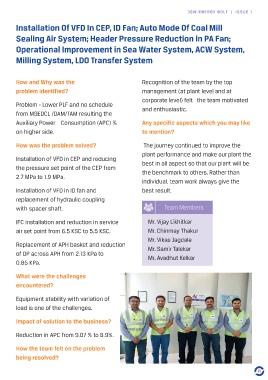
 system improvements.  IFC installation and reduction in service   Mr. Vijay Likhitkar
 Mr. Ganesh Kumar R
 How was the problem solved?  air set point from 6.5 KSC to 5.5 KSC.  Mr. Chinmay Thakur
 Mr. Anand Vaidya                                                  Mr. Vikas Jagdale
 By changing ESP Fields charging ratio and   Mr. Ajay Patil   Replacement of APH basket and reduction   Mr. Samir Talekar
 running time optimization of ERM CRM   Mr. Rajesh Padhy   of DP across APH from 2.13 KPa to   Mr. Avadhut Kelkar
 motors and hopper heaters.  0.85 KPa.
 What were the challenges   What were the challenges
 encountered?  encountered?
 After changing the ESP   Equipment stability with variation of
 parameters found difficulties in   load is one of the challenges.
 taking samples from chimney   Impact of solution to the business?
 during testing.
        Reduction in APC from 9.07 % to 8.9%.
 Impact of solution to the

 business?  How the team felt on the problem
        being resolved?


 18                                                                                                                19

