
Opportunities and challenges
The environment we operate in
Global economy
According to the International Monetary Fund (IMF), global economy grew at 3.7% in CY 2018, compared to 3.8% in CY 2017. The world economy faced headwinds owing to the US and China trade disputes and geopolitical tensions across some regions.
OUTLOOK
The slowdown from CY 2018 is expected to continue in the first half of CY 2019 too. The IMF pegs the global growth rate at 3.3% for the year, down from 3.6% previously. However, in the second half of CY 2019, growth is expected to be steady with a gradual stabilisation in emerging markets and fading headwinds in the eurozone.
Indian economy
The Indian economy continued its growth momentum. In FY 2018-19, the economy grew at 6.8% compared to 6.7% in FY 2017-18.
OUTLOOK
According to the IMF, India’s growth rate is expected to pick up to 7.3% in CY 2019 and 7.5% in CY 2020. The growth will be supported by recovery in investment and a more expansionary monetary policy stance.
Source: World Economic Outlook by IMF
Global steel demand
Global steel demand expanded 2.1%* in CY 2018, largely driven by a better-than-expected performance by China, coupled with an investment-led recovery in the advanced economies and robust manufacturing.
OUTLOOK
World Steel Association expects global demand for finished steel to grow marginally by 1.3% in CY 2019 to touch 1,735 MnT and 1.0% thereafter in CY 2020 to reach 1,751.6 MnT.
Global steel demand (MnT )
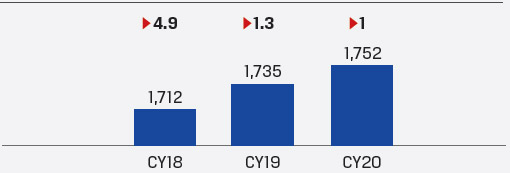
Source: World Steel Association
*Note: China closed most of its outdated induction furnaces in CY 2017, a category which was generally not captured in official statistics. With closure of the induction furnaces, the demand from this sector of the market is now satisfied by mainstream steelmakers and therefore captured in the official statistics in CY 2017. Consequently, the nominal growth rate for steel demand in China increased to 7.9% or 835 MnT. Disregarding this statistical base effect, Worldsteel expects that the underlying growth rate of China's steel demand for CY 2018 will be 2.0%, which will make the corresponding global growth rate 2.1% (Source : Worldsteel).
Demand growth (%)
India steel demand
In FY 2018-19, domestic steel demand exceeded production. Demand stood at 97.5 MnT with a y-o-y growth of 7.5% against crude steel production at 106.57 MnT, which grew by 3.3% y-o-y. The per capita consumption rose from 69 kg to 73 kg.
OUTLOOK
World Steel Association forecasts overall steel demand in India to be above 7% in CY 2019 and CY 2020. Demand is likely to grow to 100-105 MnT, with per capita consumption improving to 75-76 kg, driven by heavy infrastructure spending and faster economic growth.
By FY 2025-26, Indian steel demand is expected to be over 150 MnT – from just about 100 MnT now. This will be driven by large spends on infrastructure build-out, increasing urbanisation and rising consumption.
India steel demand (MnT )
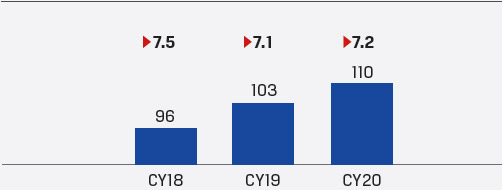
Source: World Steel Association and JPC
Trends
1. INDUSTRY 4.0
Industry 4.0 is making huge waves in the way businesses conduct their operations. With the capability to gather and analyse data across machines with more accuracy and flexibility, it has begun a manufacturing revolution and steel companies are increasingly adopting the ways of "smart production". The use of AI systems is allowing the steel industry to run almost- autonomous steelworks.
2. RECYCLABILITY OF STEEL
Given the fact that steel maintains an average of 86% recyclability, a substantial quantity of steel demand can be met using converted steel scrap. With the use of right processes and scientific methods, steel scrap belonging to lower value steel products can be converted into high-value steels.
On average, new steel products contain 37% recycled steel
3. DEMAND FOR BETTER DESIGN
Lightweight, high-strength and high-tensile steel is being demanded by customers worldwide. They find increasing applications in automobiles and white goods.
Today, the strength of steel in a vehicle’s body structure can reach 1,500 MegaPascals, which is over 8x stronger than 50 years ago*
*Steel Facts by World Steel Association
Opportunities
INTERIM BUDGET
The Finance Minister announced major investment push for the infrastructure sector in the Interim Budget. The government announced an allocation of ` 4.56 lakh crore for the sector, with communications and Indian Railways getting a share of ` 38,637 crore and ` 66.77 billion, respectively.
CONSISTENT INVESTMENTS
With the Indian GDP expected to continuously grow, the steel industry is expected to get the necessary push. Even as the country’s GDP growth remains above 5%, steel elasticity would be at around 1.1%. Given the growth estimates for Indian GDP of around 6-8% at least for a decade, the steel sector could grow at 7%.
STEADY GOVERNMENT
With the outcome of 2019 elections in favour of a steady government at the centre, the Indian economy is expected to be supported with uninterrupted implementation of ongoing reforms and programmes.
` 83,016 crore
allocated towards road transport and highways.
` 8,350 crore
to boost telecom infrastructure
With an economic growth rate of ~7%, India would need to produce an additional 7 MTPA of steel to cater to the growing demand
Challenges
SLOWING GLOBAL ECONOMY
According to the Organisation for Economic Co- operation and Development (OECD), continued trade disputes can further broaden, impacting the world economy adversely. It believes that the global economy will weaken to 3.2% in CY 2019. This would be the slowest pace in three years and down from rates of about 5% before the financial crisis.
SLOWING DOMESTIC CONSUMPTION
India’s consumption growth has recorded a slight decline. In April 2019, the sales of automobiles across segments in India fell 16% to touch the lowest in eight years, while domestic air travel contracted 4.5% for the first time in nearly five years. Volume growth in leading FMCG companies that derive more than a third of sales from rural areas has also dropped.
Source: SIAM and DGCA
TRADE PROTECTIONISM
In CY 2018, the US imposed a 25% tariff on steel imports. In response, the European Union and Canada moved to safeguard their own producers from a surge in steel imports. These safeguards have bolstered domestic production and capacity utilisation rate. However, they have had a negative impact on sectors such as construction, automotive, infrastructure, etc. With a decline in demand from the aforementioned sectors, steel companies across the globe are facing uncertainty.
RAW MATERIAL AVAILABILITY
According to the rating agency India Ratings, a delay in auction of iron ore mines, whose licences are expiring by March 2020, could hit steel production significantly in the country. Licences of 288 merchant mines, of which 59 mines are under operation, will expire by March next year.
Find a detailed discussion on the economy and the steel industry. Read More