
Conserving resources
In today’s dynamic and uncertain business environment, the key to achieving operational excellence lies in the effective management of resources. JSW Steel is committed towards responsible usage of resources and protection of the environment through sustainable practices. The Company continues to be a leader in innovation and responsible consumption, thereby limiting its environmental footprint.
Being aware of the fact that efficient use of natural resources is critical to sustainability, JSW Steel uses advanced technologies and techniques to increase production yield rates, reduce its energy requirements and facilitate the use of by-products. Without compromising on operational excellence, JSW Steel optimises resource consumption at various levels such as the conversion of two-coat paint system to unicoat paint, reduction of zinc coat thickness and use of reusable steel packaging. Also, recycled steel (scrap steel) continues to be one of the most important raw materials for the Company.
The Company is also constantly trying to reduce the impact of transporting raw materials and finished goods. To this end, the Company prioritises domestic sourcing wherever possible. Efforts are also made to transport maximum cargo via ship/rail. In FY 2018-19, about 83% of the cargo was transported via ship/rail.
The Company has developed a policy on conservation and preservation of the environment, which extends to its entire value chain. All the plants maintain the generation of emissions and waste within the permissible limits given by the Central Pollution Control Board (CPCB) / State Pollution Control Board (SPCB). There is only one case in Vasind, where The Ministry of Environment, Forest and Climate Change (MoEFCC) has mentioned that Vasind comes within 8-km zone of a wild life sanctuary. JSW Steel has submitted its response indicating that Vasind does not lie in the biodiversity zone. The Company also ensures that the risks related to the environment are part of the comprehensive risk assessment it undertakes.
Water and effluents
JSW Steel recognises that water is not just a precious resource for the society, but also plays a crucial role in the Company’s manufacturing operations. Towards this end, JSW Steel takes its responsibility for water management seriously and is constantly evaluating available technologies to improve water conservation and reuse. The Company is committed to improving its processes to enhance its water use efficiency. All JSW Steel plants are Zero Liquid Discharge (ZLD) and the wastewater generated is reused/ recycled for processes internally. Key areas where wastewater is reused include slag cooling, slag granulation plant and coke quenching process.
All JSW Steel plants are Zero Liquid Discharge (ZLD) and the wastewater generated is reused/ recycled for processes internally.
Steel slag utilisation
Steel slag disposal is one of the major solid waste management concerns for the steel industry. However, JSW Steel has implemented innovations by leveraging the Company’s technological capabilities to eliminate the impacts of slag disposal.
A large quantity of slag is generated from the BF and SMS. While the BF granulated slag is entirely sold to cement industries, slag generated in the Energy Optimising Furnace (EOF) is used in-house for road formation and is also sold to cement industries. Collaborative efforts with R&D to utilise EOF slag for paver block manufacturing has improved its utilisation. JSW Steel is the only company in India using EOF slag (20%) as a coolant in EOF process. It is also used in sinter plant as a hearth layer (70%) to replace the raw material in smaller proportions.
Solid waste management
Managing waste in an environmentally friendly, socially responsible and techno-commercially viable manner is of crucial importance in the steel manufacturing process. Waste management comprises several activities involving collection, segregation, transportation, processing, recycling and disposal of various types of wastes. JSW Steel has an integrated strategy towards efficient waste management that ensures optimal utilisation of resources and minimal disposal of solid waste.
Another potential application of steel slag is in the making of slag sand, which is a by-product of metal smelting processes and resembles natural sand. A unique slag sand preparation plant of capacity 40 TPH was installed at Vijayanagar to utilise the slag generated from iron-making processes. This project is the first of its kind in the world. The Company has used it extensively for internal roads, foundations and in townships. Further, this sand has also been used in the construction of roads, plastering work and paver block manufacturing.
Besides slag, dust from the bag filters and cyclones as well as filter cake from the GCP are completely recycled in the sinter plant. Fly ash generated from the power plant is sold to fly ash brick manufacturing units. Another innovative application of fly ash was its utilisation in the coke oven plant as a top layer in coke making to minimise burning loss.
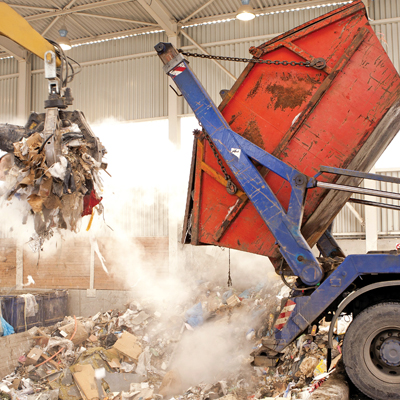
A unique slag sand preparation plant of capacity 40 TPH was installed at Vijayanagar to utilise the slag generated from iron making processes. This project is the first of its kind in the world. The Company has used it extensively for internal roads, foundations and in townships.
Key performance indicators
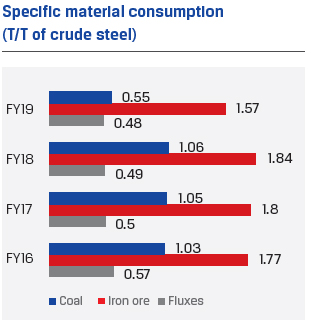
Materials at JSW Steel
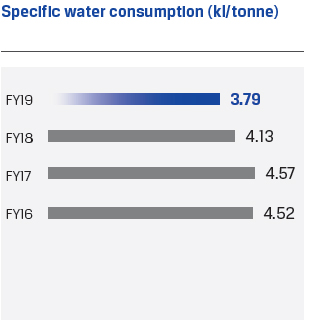
Water at JSW Steel
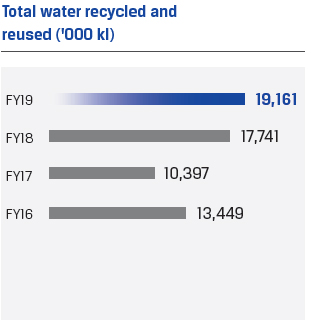
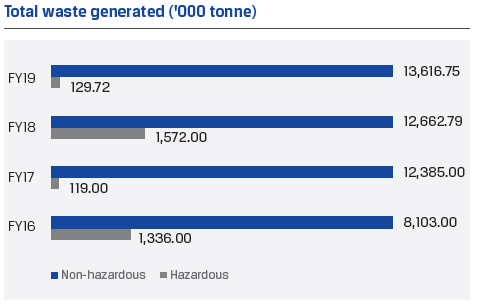
Waste at JSW Steel
Other environmental metrics at JSW Steel subsidiaries
| Disclosure | JSW SCPL | JSW SPCL | JSW ARCL | JSW INDUSTRIAL GASES | JSW SALAV | JSW MINES |
|---|---|---|---|---|---|---|
| Total water consumed ('000 m3) | 1,484.07 | 4.407 | 3,370.62 | 974 | 2,599.51 | 35.09 |
| Specific water conumption (m3/t of finished product) | 0.75 | 0.01 | 3.18 | 644.63 (m3/ million Nm3) | 3.8 | 0.070 |
| Hazardous waste generated (tonne) | 54,498.93 | 8.49 | 96.80 | 4.44 | 32.76 | 2.68 |
| Non-hazardous waste generated (tonne) | 1,62,903.42 | 71.59 | 11,009.67 | - | 130.77 | - |