Business Ethics
Business ethics refer to implementing appropriate business policies and practices with regards to subjects including corporate governance, insider trading, bribery, discrimination, corporate social responsibility, and fiduciary responsibilities. A strong and fully embedded commitment to undertaking business ethically brings considerable benefits, including improved consumer perception (leading to increased loyalty), greater investment, reduced costs, and enhanced employee motivation, involvement and interaction to name just a few. JSW has always recognized its moral obligation to do all that it can to operate its business to the highest standards of personal and professional integrity, honesty and transparency, recognizing the intrinsic benefits that good business ethics and governance provide. However, in spite of all that we have so far achieved in operating our business ethically, we recognize that there remains a potential for us to do much more. JSW is committed to embed sound governance, deliver transparency, tackle corruption, manage risks and provide value through strong and robust business ethics.
JSW Energy's Policy on Business Conduct is available here
Corporate Governance :
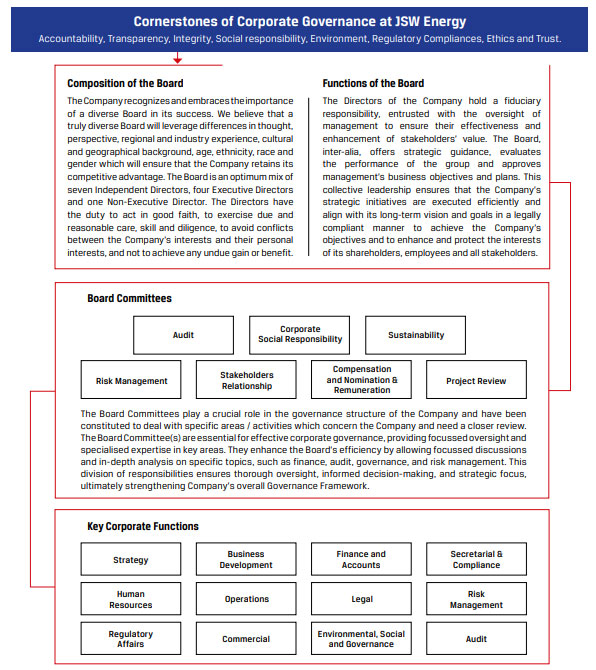
Board Accountability
7 out of 11 Board members are Independent Directors which is 63.63% of the total Board strength as against the 50% stipulated by the SEBI LODR Regulations. Mr. Ashok Ramachandran ceased to be director from 9th April 2025.
We adhere to the minimum attendance criteria as per the Companies Act, 2013. In accordance with Section 167-1 (b) of Companies Act, 2013 - The Directors are required to attend minimum of one meeting conducted during the year. The office of the Director shall become vacant, if he/ she absents himself from all the meetings of the Board of Directors held during a period of twelve months with or without seeking leave of absence of the Board. During the reporting year, 8 meetings were conducted for the Board, hence the minimum attendance requirement can be said to be 1 out of 8 which is 12.5%. Average board meeting attendance was 95.83% during FY 2024-25.
Mr. Sunil Goyal is the Lead independent director of the company. Mr. Goyal has been appointed as the Lead independent director as on 21 July 2024.
We comply with the maximum permissible limit related to Directorship requirements of the Companies Act, 2013 and Listing Obligation and Regulations Requirement i.e., a person shall not hold office as a director, including any alternate directorship, in more than twenty companies at the same time, out of which maximum 10 can be public. Out of 10 public companies, a director can hold directorship in not more than 7 listed companies. Hence, no Director holds directorships in more than 10 public companies or in more than 7 listed companies. No Director who is serving as Whole time Director / Managing Director in any listed entity is serving as an Independent Director in not more than 3 listed entities.
Pursuant to Section 167 of the Act, a Director shall incur disqualification if he/she does not meet the minimum attendance criteria and absents himself/herself from all the meetings of the Board of Directors held during a period of twelve months with or without seeking leave of absence from the Board. All Directors of the Company have duly met the attendance criteria during FY 2025.
Our Article of Association shows the procedure for election or re-election of directors, in accordance with the provisions of Section 152 of the Companies Act, 2013, each director is subject to election individually based on their tenure of 3 years. One-third of directors retire by rotation and stand for re-election annually.
At the Board level, Sustainability Committee and the Risk Management Committee convene twice a year to review climate-related matters and to ensure a comprehensive understanding and approach to nature-related risks and opportunities.
Shareholder approval required for changes in bylaw:
In accordance with the provisions of Section 14 of the Companies Act, 2013, any alteration to the Articles of Association (commonly referred to as the bylaws) of JSW Energy Limited shall be affected only by passing a special resolution at a general meeting of the shareholders. The proposed amendments must first be approved by the Board of Directors and subsequently placed before the shareholders for their consideration and approval.
CEO succession plan:
We have a robust succession planning framework in place, overseen by the Nomination & Remuneration Committee (NRC), which ensures leadership continuity across the Board of Directors, Key Managerial Personnel (KMPs), and Senior Management Personnel (SMPs). The NRC plays a strategic role in identifying and building successors for critical roles, aligning these plans with the Company’s long-term objectives. By maintaining a balanced mix of experience and fresh perspectives, the Company fosters a dynamic leadership pipeline. As part of this approach, international exposure is provided to identified successors to equip them with comprehensive business insights.
There is no limitation to directors’ liabilities
In alignment with Clause 196 of the Articles of Association, which addresses matters of indemnity and director responsibility, and pursuant to Regulation 25(10) of the SEBI (Listing Obligations and Disclosure Requirements) Regulations, 2015, as amended effective 31st December 2024, JSW Energy has taken steps to ensure appropriate coverage for its Independent Directors. As such there are no limitations on directors’ liabilities, however, as part of its governance framework, JSW Energy maintains a Directors & Officers Liability Insurance policy for a defined term, with coverage tailored to the nature and extent of risks as assessed by the Board. The current policy, effective until mid-2026, provides substantial protection, consistent with industry practices and regulatory expectations.
CEO Compensation - Success Metrics
At JSW Energy, the CEO’s compensation is structured to reflect the Company’s commitment to performance-driven leadership and long-term value creation. The annual variation in the CEO’s remuneration is directly linked to a comprehensive performance evaluation process that considers multiple dimensions of executive effectiveness. Key factors include the CEO’s tenure, leadership capabilities, domain expertise, strategic contribution to the Company’s growth, and efforts in human resources development.
Evaluations are conducted using a balanced and transparent framework that adheres to reasonable standards and incorporates both quantitative and qualitative metrics. Financial performance indicators such as sales and operating income, which underpin critical ratios like Return on Equity (ROE) and Return on Invested Capital (ROI), form a core part of the assessment. Comparative benchmarks, including stock price movement relative to energy industry peers, competitiveness, and ESG evaluation ratings, are also considered to ensure market alignment and stakeholder accountability.
CEO Compensation - Long-Term Performance Alignment
The CEO compensation is a combination of Fixed & Variable Salary, Variable component as part of the remuneration is ~28% of the total compensation of the CEO.
Out of this variable compensation, 75% payout is linked with company performance and 25% is linked to individual performance criteria. Overall EBITDA is used as a toll gate to define payout eligibility. The performance indicators for the variable compensation has weightages as follows; Company performance further linked with achievement against defined performance targets of Nominative generation 75%, Merchant Short term power sales EBITDA 10%, and safety and sustainability related KRA 15%.
We have implemented an employee stock ownership plan for employees above grade L11. The vesting period is 3 years from the date of grant of options. Vesting will take place in three tranches in a staggered manner. We have short-term bonus deferral provision in place with a performance period of 1 year, as part of ESOP scheme (2021).
Management Ownership Requirements
Remuneration policy lays down that Independent Directors, Promoter Directors and Nominee Directors shall not be entitled to any stock option of the Company, as mentioned on page no. 6 (PDF page no. 6). 7. Remuneration Policy.pdf (jsw.in).
ESG Governance Oversight
Sustainability Committee
Enterprises today are increasingly acknowledged as integral components of the broader social and environmental ecosystem. Their accountability extends beyond shareholders and financial performance to encompass responsibilities toward society and the environment, which are equally critical stakeholders. In this context, the adoption of responsible and ethical business practices has become as essential as achieving financial and operational excellence. Embedding sustainability into core business operations reflects a commitment to long-term value creation and inclusive growth.
Business Responsibility and Sustainability Reporting (BRSR) serves as a key enabler for integrating Environmental, Social, and Governance (ESG) principles into the Company’s strategic and operational frameworks. It promotes transparency, facilitates stakeholder engagement, and supports informed decision-making, while aligning corporate actions with broader developmental and environmental objectives.
Terms of Reference
The terms of reference of the Sustainability Committee, inter alia, include the following:
-
Oversee the adoption of the National Guidelines on Responsible Business Conduct (NGRBC) relating to Social, Environmental, and Economic Responsibilities of Business within the Company’s practices.
-
Ensure implementation of policies aligned with the nine key principles of the NGRBC on Social, Environmental, and Economic Responsibilities of Business.
-
Review the progress of initiatives under the purview of business responsibility (sustainability) policies.
-
Monitor business responsibility and sustainability reporting disclosures at a pre-determined frequency (monthly, quarterly, bi-annually) in compliance with applicable Listing Regulations.
-
Evaluate the progress of the Company’s business responsibility initiatives.
-
Review the annual Business Responsibility and Sustainability Report and present it to the Board for approval.
Composition
The Sustainability Committee comprises three Directors, of which two are Non-Executive, Independent Directors and one is an Executive Director. The Committee is chaired by a Non-Executive, Independent Director. The Group’s Chief Sustainability Officer serves as a permanent invitee to the Committee, providing strategic inputs and updates on sustainability initiatives.
Governance of Climate-Related Issues
At the management level, oversight is driven by structured collaboration:
-
Executive Committee: Comprising the JMD & CEO, CFO, COO, Section Heads, and special invitees, the committee meets monthly to review sustainability performance and integrate climate-related KPIs into decision-making.
-
Corporate Functions Teams: Cross-functional collaboration between the risk, sustainability, and strategy teams ensures climate considerations are embedded into business planning. These teams maintain active engagement with plant sites and facilitate ongoing risk reviews.
ESG Governance Structure
-
The ESG governance structure at JSW Energy aligns its corporate strategy with sustainability goals, enabling long-term value creation while enhancing risk management and resilience. By embedding ESG considerations into decision-making, JSW Energy promotes transparency, accountability, and stakeholder trust, strengthening reputation and investor confidence. This approach empowers the Company to drive sustainable growth, safeguard the environment, and contribute meaningfully to society.
-
The Sustainability Committee leads JSW Energy’s climate action agenda. It evaluates climate-related risks and oversees key material issues such as water stewardship and biodiversity. The Committee Chair regularly monitors progress against targets, ensuring alignment with the Company’s broader sustainability vision and effective oversight of critical ESG priorities
Whistleblower Policy
Details related to whistleblower incidents received are kept confidential ,all reports are treated with strict confidentiality, and access to the information is restricted to authorized personnel involved in the investigation.
Zero tolerance policy for retaliation : We maintain a zero-tolerance policy towards any form of retaliation against whistleblowers. We are committed to protecting those who report concerns in good faith, and any retaliatory action is treated as a serious violation of our Code of Conduct.
Provision of training on the use of reporting channel to ensure that our employees are aware of and confident in using the whistleblowing mechanism, we conduct regular training and awareness programs. These initiatives help our teams understand how to access the reporting channel, what types of issues can be reported, and the protections available to them.
Disclosure on the process for investigating the reported breaches: Every report we receive is handled through a structured and transparent investigation process. We begin with a preliminary assessment to determine the validity and seriousness of the concern. If necessary, we initiate a detailed investigation, with findings reviewed by the Ethics Committee and, where appropriate, escalated to the Audit Committee. We ensure that all outcomes are documented, corrective actions are implemented, and follow-ups are conducted to prevent recurrence.
Third-party Reporting Channel:
The Ethics Helpline is a third-party service and is multilingual. ‘Reporters’ can access the helpline through Phone, Email, Web Portal or Post Box. The complaints are processed by trained professionals to assure collection of accurate information and protection of the ‘Reporters’ confidentiality. We have launched the Ethics 24*7 Helpline as a confidential platform for reporting misconduct. Operated by third-party provider Integrity Matters, the service is accessible in multiple languages, including English, Hindi, Tamil, Telugu, Marathi, Kannada, and Bengali, ensuring wider reach and greater inclusivity across our workforce.
CEO-to-Employee Pay Ratio
Our Median compensation for the employees during the reporting year is 9 lakhs.
Risk Governance
The Risk Management framework is guided by the Group level Risk Management team, cutting across all business verticals. Monitoring and auditing of the risk management process is also taken care by the Risk committee. During meetings with the Board of Directors, the Board is presented with the aspects of Global Energy sector Scenario, Global/Indian Economy, significant geopolitical events impacting energy sector and power industry, risk management practices, including climate-related risks Company’s Financials, Sales, Production, Business Strategy, Subsidiary’s performance before taking on record the financial results of the Company.
The Company employs a balanced risk‑management strategy that combines bottom‑up inputs with top‑down oversight to ensure comprehensive coverage of strategic, operational, technological, reputational, legal, ESG, financial, , and emerging risks.
The Risk Management Committee (RMC), chaired by an Independent Director, provides independent oversight of long‑term strategic and macro risks and focuses on executing strategies and mitigating unintended risks such as performance and process risks.JSW Energy’s delegation of authority across functions creates effective checks and balances within the system to close possible gaps in decision‑making and control.
We have implemented an Internal Audit software to record, track, and close audit observations, providing end‑to‑end visibility and accountability. At the start of each year, Internal Audit prepares an Annual Audit Plan after considering business and process risks; the frequency of audits is decided by risk ratings of areas/functions. The audit plan is reviewed periodically to include areas that have assumed significant importance in line with emerging industry trends and the aggressive growth of the Company. In addition to in‑house reviews, we engage external expert firms (including reputed accounting firms) to audit critical areas, strengthening independence and assurance.
Risk Management Process
Our Enterprise Risk Management (ERM) framework serves as a structured approach to identify, prioritise, manage, monitor, and report on key risks and emerging risks. We adhere to the globally recognised Committee of Sponsoring Organisations (COSO) framework for ERM, which enables the seamless integration of internal controls into our business processes.
Our approach to enterprise-wide risk management encompasses both bottom-up and top-down strategies. The bottom-up process involves the identification and regular assessment of risks by our respective plants and corporate functions, followed by the implementation of effective mitigation strategies. Concurrently, our Risk Management Group (Senior Leadership Team) and the Risk Management Committee (RMC) adopt a top-down approach to identify and evaluate the long-term, strategic and macro risks to our business.
Our Risk Appetite Framework is deliberately structured to align with our long-term strategic objectives, financial resilience, and regulatory responsibilities.
A measured risk appetite informs our approach to strategic and financial exposures, enabling a prudent balance between sustainable growth and operational stability.
Also, risks are identified based on scanning of external environment to ensure that it is aligned with our Risk appetite framework. The identified risks are evaluated by the senior management depending on the impact and the likelihood and the final list of risks are prioritised for the organisation. Risk Severity is determined after considering 2 factors: Impact on Business & Probability of Occurrence. Basis this, a Risk Severity matrix is constructed, and the risk appetite of the company is determined accordingly.
| Risk Type | Risk Name | Risk Rating | Risk Movement* | Impact | Risk Mitigation Strategies |
| Financial Risk | Interest rates | Low |  |
RBI reduced Repo rate by 1% to 5.5% p.a. as inflation has remained within target range of 4% to 6% p.a. US Fed has slashed its key interest rate by 100 bps since August 2024 to 4.5%. |
Evaluation of growth projects are done on conservative basis over life of PPA. Hence, underlying cash flows and return metrics over a long-term have adequate protection from short-term volatility
|
| Financial Risk | Recovery of dues from DISCOMs | Low | |
Due to poor financial health, payments from the DISCOMs against our power supply are delayed. This impacts the working capital cash flow | Regular follow up is being made for the overdue receivables |
*Impact X Likelihood
This combined bottom‑up / top‑down construct ensures local risk visibility (at plants and functions) and inputs from central functions along with inputs from Senior Leadership and the RMC, so that mitigations are implemented promptly.
Review of Company's Risk Exposure
Our company’s risk exposure is reviewed twice a year at the Board level Committee meeting.
Our company’s Internal Audit function encompasses best global standards and practices of international majors into its operations. The Internal Audit Department reports to the Audit Committee comprising Independent Directors who are experts in their respective fields. These Independent directors are also part of Risk Management Committee. Internal Audit department prepares annual audit plan after considering risks reported in RMC. Internal Audit also reviews Risk Management measures reported in risks
The Internal Audit function has enterprise‑wide access to information, enabled by ERP across the organisation, ensuring timely, complete, and reliable evidence for audits.
Training for Risk Management
Our Enterprise Risk Management (ERM) framework, implemented in 2010, ensures that all designated risk owners at both plant and corporate levels receive awareness training through e-learning modules on the Risk Management framework, enabling them to identify new risks effectively. The Board is kept informed about the risk management process and sector-specific risks, while Independent Directors are familiarised with their roles, rights, responsibilities, the nature of the industry, business model, and related risks as part of the Board Familiarisation Program as well.
A comprehensive e-learning module on "Risk Management" is available to all JSW Energy’s Directors, employees, inclusive of senior management through JSW Learning Academy, This training ensures a thorough understanding and effective implementation of risk management across the organisation.
Incorporation of Risk Criteria in development of products and services
As a thermal power generating business the major risk for JSWEL is generation of GHG emissions as the future of the power sector demands power generation with a mix of renewable energy. To address this risk, JSW Energy is presently engineering an energy mix makeover by investing in renewable energy assets to become a net zero company latest by 2050. Tangible goals at the organizational level are set for reducing GHG emissions, solid waste generation, water management & achieving no net loss in biodiversity. We aim to implement a cleaner fuel mix and reduce specific fuel consumption for our existing thermal plants by vastly scaling our portfolio of greenfield renewable assets, across wind and solar. We also evaluate emerging technologies across green hydrogen; off-shore wind; storage solutions including battery and pumped hydro storage. Having surpassed our target of 10 GW installed generation capacity by FY 2025, we unveiled Strategy 3.0 charting the course for FY 2030, with a stated goal to achieve 30 GW power generation and 40 GWh energy storage capacity by FY 2030.
Financial incentives which incorporate risk management metrics
At JSWEL safety is identified as a part of KRA for Senior executives with a mandatory weightage of 15-25%. The variable performance pay (incentives) is linked to this KRA. The following safety criteria are part of the KRAs for Senior executives:
- Lost time injury frequency rate (LTIFR): Reduction target as per management decision taken annually.
- Number of reportable incidents: Reduction target as per management decision annually.
- Zero Fatal incidents
The same is considered during the annual performance appraisal.
Emerging Risk
| Name of Emerging Risk | Category | Description | Impact | Mitigating Actions |
| Challenge of integration of Artificial Intelligence in energy sector |
Technological |
The integration of artificial intelligence (AI) presents unforeseen risks of operational disruption, data inconsistencies, complexity of integrating AI systems in the existing infrastructure, data privacy, and the need for specialized skills and trainings. |
The integration process may cause temporary operational disruptions as legacy systems are upgraded or replaced. Increased reliance on AI systems can expose JSW Energy's operations to new cybersecurity threats. Additionally, there may be a shortage of skilled personnel required to develop, implement, and maintain AI systems. Furthermore, the initial investment in AI technology and ongoing maintenance can be substantial. |
We have invested in robust cybersecurity measures, including firewalls, intrusion detection systems, and encryption technologies, to protect AI systems and sensitive data. Contingency plans are in place for technology failures, supported by backup systems and disaster recovery protocols. Thorough risk assessments are conducted to identify potential vulnerabilities in AI systems, with mitigation strategies developed accordingly. Additionally, a data governance framework is being implemented to ensure data quality and security. Regular training sessions are provided to employees on digital transformation, AI ethics, and responsible AI development. |
| Skilled Human Capital and Specialist Talent Gaps |
Operational / Strategic |
Business expansion in Thermal and New Energy segments, along with backward integration through manufacturing activities, is occurring in a highly competitive and dynamic talent landscape. This includes Renewable Business initiatives such as Wind, Solar, Pump Storage Projects, and Battery Energy Storage, as well as Solar Module, Battery, and Wind Blade Manufacturing. Additionally, scaling renewable energy, storage, and emerging hydrogen businesses requires niche expertise in digital, operational technologies (OT), and new energy domains. While we have expanded leadership and capability development programs, rapid business growth increases the risk of talent retention challenges and skill mix gaps. |
Execution delays are likely due to a shortage of critical skills, resulting in higher dependence on contractors for specialized roles. This increases the risk of potential safety and compliance lapses and drives up hiring and retention costs. |
An aligned hiring strategy is being implemented through RPO engagement for volume hiring, walk-in drives across states for select functions, and empanelment of segmented recruitment consultants for Renewable, Hydro, Thermal, and PSP businesses. Employee referrals will be encouraged by introducing an attractive policy, while cadre building will be strengthened through the intake of fresh Diploma, Engineering, and Management trainees. Market mapping initiatives are also underway to ensure proactive talent availability. Additionally, skill development programs are being designed in partnership with external agencies, customized to business needs, such as through the Philips Institute. Further, high-potential talent from mergers and acquisitions will be evaluated for expanded or critical roles. |
Code of Conduct: Systems and Procedures
For us at JSW Energy, ethical and responsible business practices are of utmost importance, and our policy on business conduct serves as a guiding force for all employees. We are steadfast in our commitment to promoting a culture that aligns with this policy.
All employees, including our esteemed board of directors, must comply with the code of conduct and the laws and regulations of the countries in which we operate. Failure to comply with these standards can result in substantial fines, for the concerned personnel. Covered employees are accountable for their conduct and will face consequences for any breach of the code of conduct. Any such violation will undergo a thorough investigation and may result in disciplinary action. Moreover, employee performance is linked to adherence to the Code of Conduct, with potential consequences including penalties such as verbal warning, warning letter, monetary penalties (as applicable), censure, holding monthly incentives, recovery of whole or part monetary loss caused to company by the negligence or breach etc.
Reporting on Breaches
There were no cases related to money laundering reported during FY 2024-25.
Cyber security
For us, cybersecurity is a top priority. As we embed digitalisation into our operations, our business is more prone to cyber threats. We have meticulously devised ways through which we can protect our business and our stakeholders, through various vulnerability and breach assessments, keeping ourselves updated as per the industry best practices. This is headed by our Chief Information Officer and overseen by the Risk Management Committee.
Information security-related business continuity plans
At JSW Energy, we recognize the critical importance of safeguarding our digital infrastructure and ensuring business continuity in the face of potential cyber threats. Our information security-related business continuity plans are designed to maintain operational resilience, minimize downtime, and protect sensitive data during disruptions. These plans are regularly reviewed and tested to ensure effectiveness.
Internal audits of the IT infrastructure and/or information security management systems
We also conduct internal audits of our IT infrastructure and information security management systems to identify vulnerabilities, assess whether ISMS conforms to JSW’s own requirements for its Information Security, the requirements of the standards and to evaluate effectiveness of the IT general controls. Corrective actions shall be taken in case of any non-conformity to the requirements. The effectiveness of the corrective action taken shall be reviewed and changes shall be made to the information security management system, if required. The audit is carried out as per the Internal Audit Plan approved by the Audit Head.
Escalation process for employees to report incidents, vulnerabilities or suspicious activities
To further strengthen our security posture, we have established a clear escalation process that enables employees to report incidents, vulnerabilities, or suspicious activities promptly. This process ensures that all reports are addressed swiftly by the relevant teams, with appropriate follow-up and resolution to prevent recurrence and mitigate risks.
Information security awareness training:
To ensure that our employees are aware of and confident in using the whistleblowing mechanism, we conduct regular training and awareness programs. These initiatives help our teams understand how to access the reporting channel, what types of issues can be reported, and the protections available to them.
In FY 2025, there were no cases of cybersecurity threats or Data breaches.
Stakeholder Engagement Framework
We have a well-established internal Stakeholder Engagement Framework. Our procedure is applied at all local operations and as part of our supply chain. Our stakeholder engagement strategy enables us to formulate separate strategic initiatives to strengthen our relationship with each of our stakeholders including local communities.
As part of our Stakeholder Engagement program we conduct Social Impact Assessments for all new projects, allowing us to mitigate any negative impacts on the local communities.
The framework guides the company in formulating a plan to identify and prioritize the stakeholders. The process of stakeholder identification includes identifying those stakeholders that are directly and indirectly affected by the site/project and verifying stakeholder representatives. Our local stakeholders included local communities and their representatives, self-help groups, district level government authorities, NGOs, and PRIs. Local Communities also include affected communities, i.e., those directly affected by any adverse environmental or social aspects associated with the site/project’s operations. As part of the identification process, we also identify vulnerable groups that include marginalised and disadvantaged people in society, indigenous peoples, local tribes, etc. We are committed to protecting and empowering these groups by addressing their unique needs and concerns.
Moreover, we conduct periodic meetings with the surrounding communities to understand their needs and concerns providing a platform for transparent and collaborative two-way dialogue. In certain situations, capacity-building programs are established to enable affected stakeholders (particularly local communities and organizations) to be able to participate fully and effectively in the process. Open communication helps us review the perception of our local stakeholder’s perspective on our engagement strategy and make changes, if necessary.
Grievance Mechanism
We have a robust governance mechanism that provides a clear communication channel between representatives and communities. The local stakeholders can send an email to our community relations team at the corporate level or any of the plant locations to register their grievances. A defined escalation process allows us to keep track of the grievances, in the reporting year we received 0 complaints from local communities. In cases where the conventional grievance mechanism is not accessible, the stakeholders can approach the CSR offices present at each site. Communication through the CSR offices provides a dedicated channel for the local stakeholders to report their grievances to the CSR department responsible for Stakeholder Engagement. Our process helps us understand the grievance of the local communities and maintain a register recording all the grievances shared."
Double Materiality Assessment
We conduct materiality assessment once every two to three years. Our company engages in continuous interactions with its external and internal stakeholders to understand their perspective and identify their key issues and concerns. This facilitates in identifying topics of significance to both its internal and external stakeholders. This exercise helps us to plan strategies for managing the risks and harnessing the opportunities.
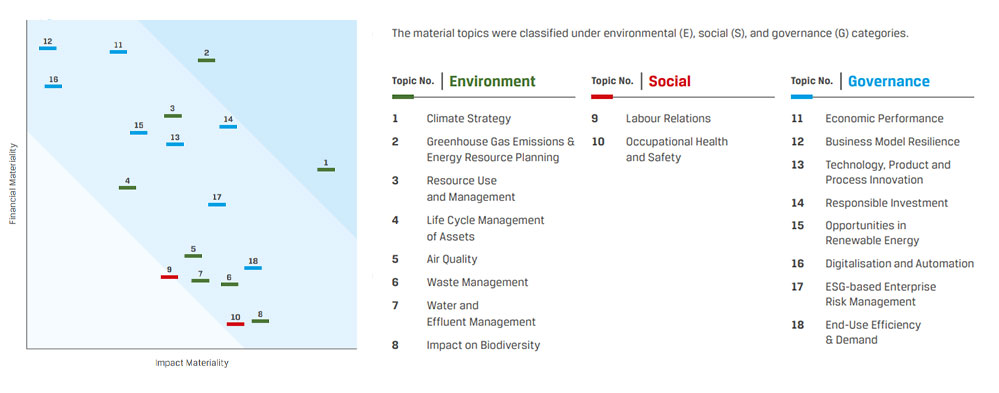
In furtherance to this, to align with the evolving ESG landscape we conducted the materiality assessment exercise as per the principle of double materiality considering the aspects of Financial and Impact Materiality with approval from our senior Management. Materiality assessment integrated in company's ERM process.
As part of our ongoing assessment, the company has identified three most significant material topics: Climate strategy, Resource use and Management and Air Quality
Climate Strategy, Resource Efficiency and Air Emissions
Top Material topics and impacts identified |
|||
| Material Issue 1 | Material Issue 2 | Material Issue 3 | |
|
Topic |
Climate Strategy |
Resource Use and Management |
Air Quality |
| Description |
Climate strategy is crucial for JSW Energy as it directly influences the company’s long-term sustainability and is aligned with India's net-zero ambitions. As one of the fastest-growing power companies in India, JSW Energy is committed to significantly reducing its carbon footprint by diversifying its energy portfolio and investing heavily in renewables. The company has already achieved an installed capacity of 10.9 GW in FY 2025, with 48% coming from renewable sources (5,217 MW). It has also set an ambitious goal of reaching 30 GW of generation capacity (majorly renewable) and 40 GWh of energy storage by FY2030. This positions JSW Energy at the forefront of India's clean energy transition. The company has committed to becoming net-zero (carbon neutral by 2050) and to reduce its Scope 1 and 2 GHG emission intensity by 50% from 2020 levels by 2030. As of 2025, JSW Energy has already achieved a 22.4% carbon reduction. JSW Energy also achieved GHG intensity of 0.59 tCO₂e /MWh, down from 0.62 in FY2024. The company has a target to achieve GHG Emissions (Scope 1+2) intensity to be achieved to 0.39 tCO2e/MWh by FY 30. A governance structure, including the Board Sustainability Committee supported by the Chief Sustainability Officer and Corporate Sustainability Team, ensures climate considerations are fully integrated into decision-making processes. The company reviews risks such as climate change, water stewardship, and biodiversity and provides regular updates to the board, demonstrating strong governance oversight of the climate agenda. Our mitigation strategy includes several focus initiatives: Circularity in action: We continue to transition from coal-based boilers to utilizing waste gases from our group company JSW Steel, reducing fossil fuel dependency and policy/market risk. Reduction of fossil fuel dependency which eliminates the need for fossils fuels, mitigating policy and market risks associated with their use. Internal carbon pricing: Our Internal Carbon Price (ICP) of 12 USD/tCO2e allows for a balanced assessment of the feasibility of proposed low-carbon initiatives in the near and medium term Sustaining competitiveness by ensuring our low carbon journey( by increasing renewable energy share in our existing portfolio) continues while maintaining our competitive edge in the market. Impact on External Stakeholders We have avoided 28.57 million tCO₂e of GHG emissions from the baseline due to RE generation. JSW Energy not only ensures compliance but also secures a competitive advantage by providing affordable, clean, and reliable power to its customers. Our climate strategy thus creates positive impacts across the environment, society, and value chains while ensuring resilience in a low-carbon future. |
Water is a critical resource for JSW Energy as it underpins essential operations such as cooling, ash handling, and fire protection. Recognising the increasing risk of water scarcity and climate variability, the company has prioritised water stewardship and resource efficiency across all its facilities. JSW Energy has committed to reducing specific freshwater consumption by one-third by 2030 (baseline 2020). In FY2025, specific freshwater intake stood at 0.99 m3/MWh, reflecting an 11% reduction against the 2020 baseline. Total water withdrawal in FY2025 was 126.68 million kilolitres, primarily from seawater (91.26 million kilolitres), with freshwater needs met through surface water (34.85 million kilolitres) and groundwater (0.52 million kilolitres). The company has a target to achieve Sp. Freshwater intake of 0.68 (m3 /MWh) by FY 30 The company has maintained zero liquid discharge compliance across all thermal power plants, where wastewater is treated, recycled, and reused for operational or horticultural purposes. In FY2025, over 4.01 million cubic metres of wastewater was recycled and reused, underscoring the closed-loop system that minimises freshwater withdrawal and prevents effluent discharge. Rainwater harvesting systems have been strengthened across sites, including a 35,000 cubic metre reservoir at Ratnagiri to ensure summer availability. Site-level initiatives continue to drive conservation. At Barmer, the plant was certified as a water-neutrality-aspiring site following a detailed water risk assessment. Across all locations, adoption of dry robotic cleaning of solar panels reduced freshwater consumption significantly. Impact on External Stakeholders The implications extend beyond the company to a broad range of stakeholders, including local communities, regulators, investors, customers, suppliers, and the environment. For local communities, JSW Energy’s responsible water use helps prevent over-extraction, ensuring adequate water availability for agriculture, domestic needs, and other essential purposes, especially in water-stressed regions. Regulatory authorities are increasingly emphasizing sustainable water practices. Companies that prioritize efficiency, like JSW Energy, are better positioned to comply with evolving regulations, avoid penalties, and maintain their social license to operate. For investors and financial institutions, efficient water use reflects strong resource management, enhancing reputation, reducing operational risks, and potentially improving access to capital. Conversely, water shortages or insufficient supply could disrupt operations, leading to production delays and higher costs. |
Conventional power generation continues to contribute to air emissions such as dust/particulate matter (PM), sulphur dioxide (SO₂), and nitrogen oxides (NOₓ). As an environmentally responsible organization, JSW Energy recognises its role in addressing these emissions and is committed to minimizing air quality impacts through advanced pollution control technologies and operational excellence. We strictly comply with the emission limits set under the MoEF&CC’s revised emission norms (2015), and all operating units have achieved, or are on track to achieve, full compliance. For example, Ratnagiri Unit 4 (2 × 300 MW) is already equipped with high-efficiency electrostatic precipitators (ESPs), low-NOₓ burners, and flue gas desulphurisation (FGD) systems, ensuring alignment with SO₂ and PM standards. Similarly, our Barmer units (8 × 135 MW, CFBC technology) and other units are compliant with SO₂ and NOₓ norms, with ESP modifications completed on schedule. The company has targets to achieve the following levels for Air emissions by FY 30
During FY25, we achieved significant reductions in emission intensities:
Our mitigation strategy and plant-level initiatives include: FGD installations: Full-scale FGD at Ratnagiri has effectively reduced SO₂ emissions, with timelines for other units aligned to MoEF&CC requirements. Automation and monitoring: Introduction of advanced automation and monitoring systems, such as ESP control logic and continuous emission monitoring systems (CEMS), ensures real-time compliance and operational efficiency. Impact on External Stakeholder: |
| Target/metric linked to executive compensation |
Sustainability objectives across all operations and regions are embedded in the annual Key Responsibility Areas (KRAs) of top management and cascaded down to line management performance indicators. Approximately 15-20% of KRAs for key senior management roles are directly tied to safety and sustainability parameters. For senior leadership, including the Executive Committee, KRAs focus on advancing the ESG agenda. Key priorities include expanding the renewable energy portfolio to drive decarbonization, reducing fresh-water consumption, 100% fly-ash utilization, committed to achieving no net-loss status for biodiversity, lowering air emissions, strengthening community engagement, and promoting good governance through collaborative initiatives and stakeholder engagement. |
||